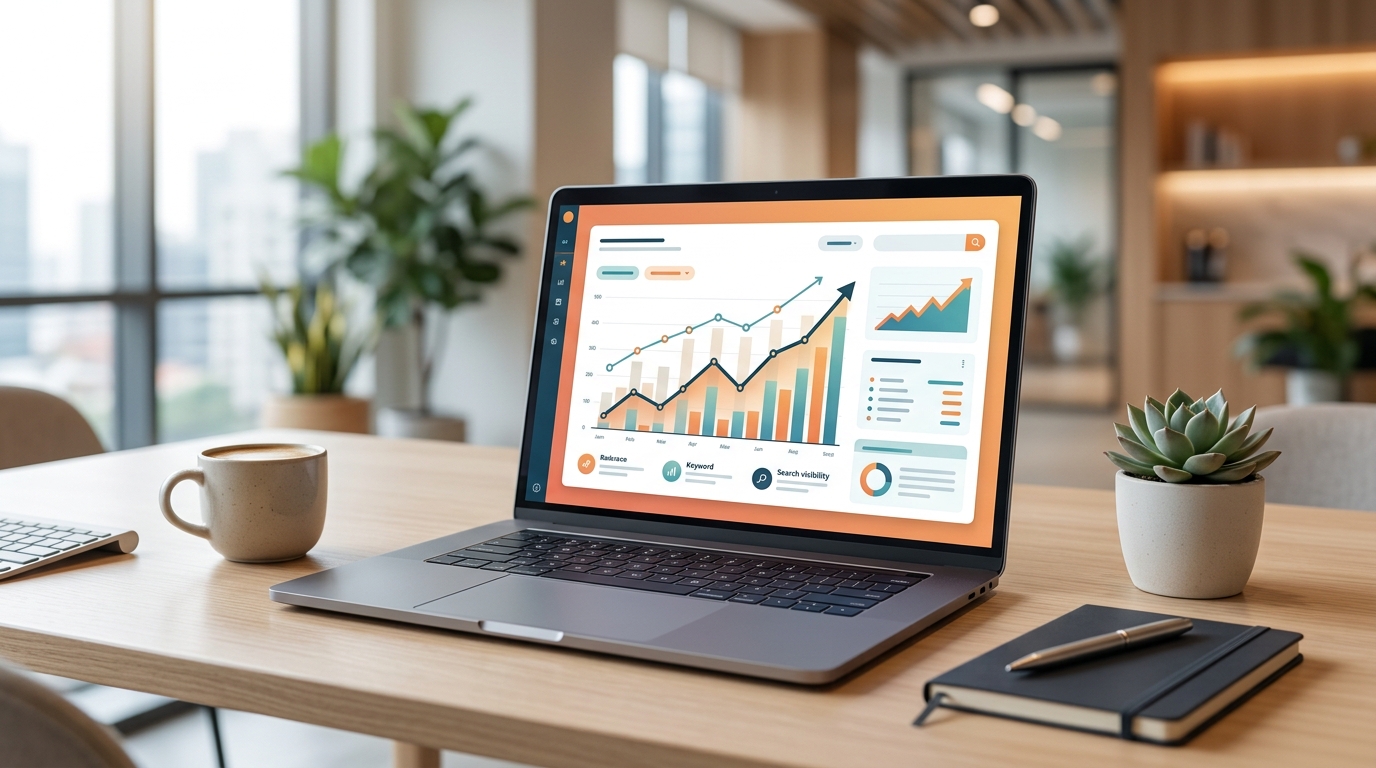
Rank tracking software monitors where your website appears in Google search results for specific keywords. You enter your keywords, the tool checks Google daily or weekly, and you get a clear number — position 1, position 7, position 34 — so you can see whether your SEO is working or not. Without it, you're guessing.
What Does Rank Tracking Software Actually Do?
At its core, a rank tracker checks Google (and sometimes Bing or other engines) for your chosen keywords and records your position over time. That's it. The value isn't in any single snapshot — it's in the trend. Are you climbing from position 22 to position 8? Dropping from 4 to 11? That movement tells you what's working and what needs fixing.
Most rank tracking tools also let you:
- Track rankings by location — useful if you serve customers in a specific city or region
- Monitor competitors alongside your own site
- Group keywords by topic or service area
- Get alerts when rankings change significantly
- See search volume next to each keyword so you know which positions actually matter
Why Rank Tracking Matters for Small Businesses
If you're running a small business, you probably can't afford to wait six months to find out whether your SEO investment did anything. Rank tracking gives you early feedback. If you publish a new service page or blog post, you'll start to see movement — or the lack of it — within a few weeks.
One concrete benchmark worth knowing: research consistently shows that the top result on Google captures roughly 27–30% of all clicks for a given keyword, while position 10 gets under 3%. That's a ten-fold difference in traffic between first and last on page one. Rank tracking tells you exactly where you stand — and how far you have to go.
For local service businesses especially, tracking local pack rankings (the map results) separately from organic listings matters. A plumber in Copenhagen needs to rank in the local pack, not just the organic blue links. Good rank tracking software handles both.
What to Look For When Choosing Rank Tracking Software
Accuracy and Update Frequency
Daily updates beat weekly ones when you're actively working on SEO. Some cheaper tools only refresh rankings once a week, which slows your feedback loop. Check how often the tool actually pulls fresh data before you commit.
Local and Country-Specific Tracking
If your customers are in Denmark, you need rankings from Google.dk, not Google.com. Many global tools default to US results and give you useless data. Make sure you can set the right country and — if relevant — city-level tracking.
Competitor Tracking
Knowing you're in position 5 is more useful when you also know your main competitor is in position 2. Side-by-side competitor ranking data helps you prioritise which keywords to fight for first.
Ease of Use
If the dashboard takes an hour to learn, most business owners stop logging in. The best rank tracking tools show you what changed, why it matters, and what to do next — in plain language, not a wall of charts.
Integration with Other SEO Data
Rank tracking alone won't fix your SEO. It's most useful when it sits alongside keyword research, content publishing, and technical audits. Standalone rank trackers are fine, but an integrated platform saves you from jumping between five different tools.
Common Rank Tracking Mistakes to Avoid
- Tracking vanity keywords only. Ranking number one for your brand name means nothing. Track the keywords your customers actually search before they know your name.
- Checking rankings manually. Searching your own keyword in Google and looking for yourself gives inaccurate results because Google personalises results based on your history. Always use a proper tracking tool.
- Obsessing over daily fluctuations. Rankings move constantly, sometimes by several positions in a day with no action on your part. Look at four-week trends, not yesterday's number.
- Ignoring page-two positions. A keyword sitting at position 11 or 12 is close to page one. That's often easier to move than a keyword stuck at position 45.
Does SEO Autopilot Include Rank Tracking?
Yes. SEO Autopilot tracks your Google rankings automatically as part of the platform. You don't set it up manually — when you add a keyword, it gets tracked. You see your positions in a clean dashboard, with movement highlighted so you can see what's improving and what isn't.
It also sits alongside the rest of the platform: keyword research, article writing and publishing, technical site audits, and AI-visibility checks (so you know whether tools like ChatGPT and Perplexity are mentioning your business). Everything runs on a weekly or daily schedule without you touching it.
If you're a small business owner who wants to know where you stand on Google without logging into a separate tool for every piece of information — that's exactly what SEO Autopilot is built for.
Ready to see where your site actually ranks? Start a free trial at seoautopilot.dk and get your keyword positions tracked automatically from day one.
What is rank tracking software?
Rank tracking software automatically monitors where your website appears in Google search results for specific keywords. It records your position over time so you can see whether your rankings are improving or dropping without manually searching Google yourself.
How often does rank tracking software update rankings?
It depends on the tool. Most good rank trackers update daily, though some budget options only refresh weekly. Daily updates give you faster feedback when you make changes to your site or publish new content.
Can rank tracking software track local search results?
Yes, most rank tracking tools let you specify a country and many allow city-level tracking. This matters for local businesses because rankings in Copenhagen can differ significantly from national results, especially in the Google Maps local pack.
Is rank tracking software accurate?
Professional rank tracking tools are generally accurate, but they measure rankings as seen by a neutral user in your chosen location — not your personal Google results, which are skewed by your browsing history. Manual searches on your own device are far less reliable than using a dedicated tracker.
Do I need separate rank tracking software or can it be part of an SEO platform?
You can use a standalone rank tracker, but it's usually more efficient to use a platform that includes rank tracking alongside keyword research, content tools, and site audits. Switching between multiple tools wastes time and makes it harder to connect ranking changes to specific actions you've taken.