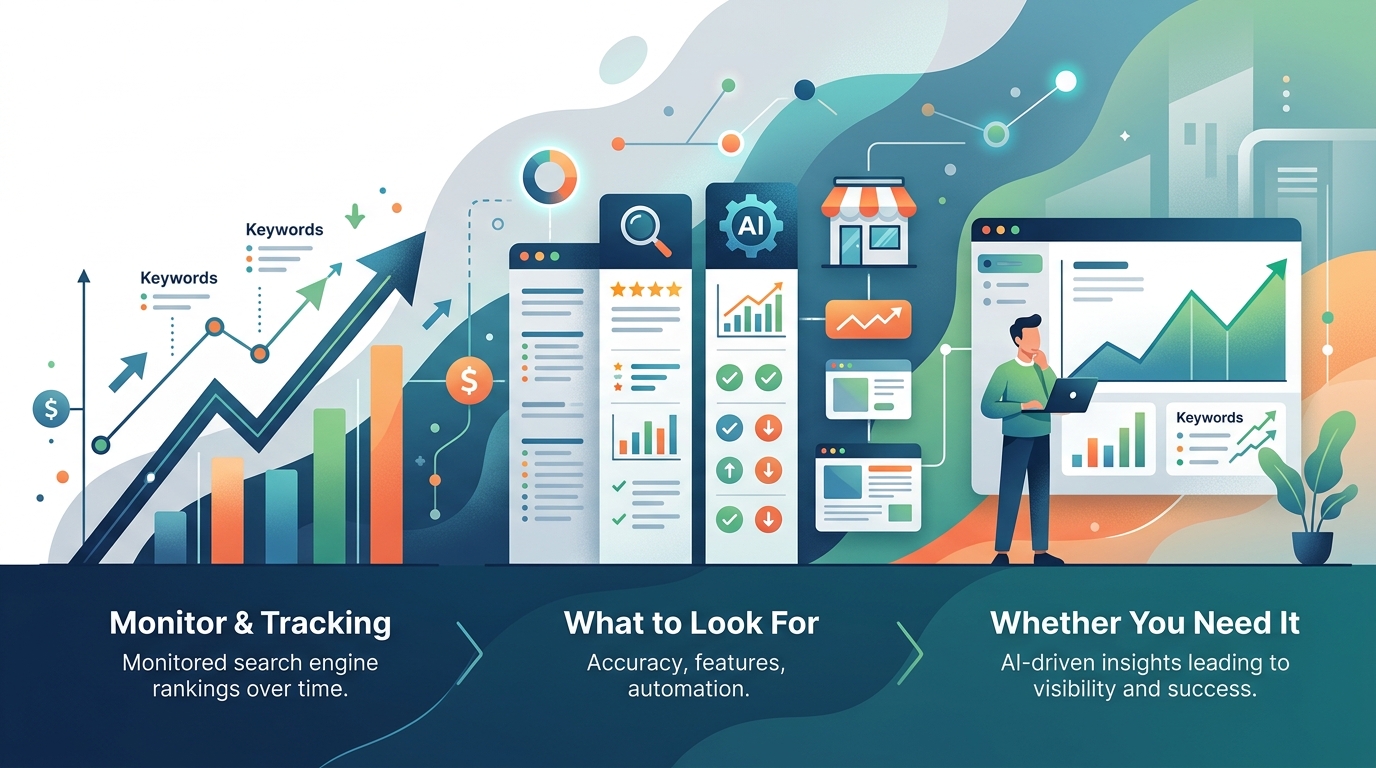
Rank tracking software monitors where your website appears in Google and other search engines for specific keywords. It records your position over time, alerts you to drops, and shows whether your SEO work is actually moving the needle. Most tools check rankings daily or weekly and display the data in a simple dashboard so you can see progress without logging into Google Search Console manually every day.
What Does Rank Tracking Software Actually Do?
At its core, a rank tracker answers one question: for a given search term, what position does my website show up in? But a good tool does more than pull a single number. It tracks position changes over time, compares your rankings against competitors, breaks results down by location or device, and flags when a page drops out of the top 20. That last part matters — a ranking can disappear overnight after a Google algorithm update, and you want to know before your phone stops ringing.
Position tracking vs. visibility score
Most tools show both. Your position is the raw rank for one keyword. Your visibility score aggregates positions across all your tracked keywords into a single percentage, giving you a quick read on overall search presence. For small businesses tracking 20 to 100 keywords, visibility score is often the more useful daily check.
Why Rank Tracking Matters for Small Businesses
If you are spending time or money on SEO — writing blog posts, fixing technical issues, building links — rank tracking is how you know if any of it is working. Without it, you are flying blind. You might feel busy doing SEO tasks while your rankings are quietly sliding in the wrong direction.
One concrete number worth knowing: according to industry data, the first organic search result on Google gets roughly 27% of all clicks, while position 10 gets under 3%. The difference between ranking fifth and first is not cosmetic — it is the difference between steady inbound leads and near-zero traffic from that keyword. Rank tracking shows you exactly where you sit in that range and whether you are moving up or down.
What to Look for in a Rank Tracking Tool
- Accurate local tracking. If you serve customers in a specific city or region, you need a tool that checks rankings from that location, not a generic national result.
- Daily or weekly automated updates. Manual checks are easy to skip. Automated runs mean the data is always current without you having to remember.
- Competitor tracking. Knowing your own position is useful. Knowing you are in position 6 while your closest competitor sits at position 2 is actionable.
- Integration with other SEO data. Rank tracking alone is a narrow view. It gets more useful when it sits alongside keyword research, content performance, and technical audit data in one place.
- Clean, readable reports. If you have to spend 20 minutes interpreting a dashboard to understand what happened this week, the tool is not working for you.
Standalone Tools vs. All-in-One Platforms
You can buy dedicated rank tracking software like SERPWatcher or AccuRanker, or you can use a broader SEO platform like Ahrefs, Semrush, or Moz that includes rank tracking as one feature among many. Standalone tools tend to be cheaper and often more precise on tracking alone. Broader platforms cost more but eliminate the need to switch between five different tools.
For most small business owners, the real question is not which rank tracker is technically superior — it is whether you will actually log in and act on the data. A tool you check once a month because it feels complicated is worse than a simpler tool you understand and use every week.
How Rank Tracking Fits Into a Full SEO Workflow
Rank tracking is a measurement layer, not a strategy on its own. It tells you what is happening, not what to do about it. A complete SEO workflow also includes keyword research to find the right terms to target, content creation to build pages that rank, technical audits to catch issues that block indexing, and link building to improve authority. Rank tracking ties it all together by showing you which of those efforts are producing results.
One newer addition to that workflow is tracking AI visibility — whether your business shows up when someone asks ChatGPT or Perplexity a question relevant to your services. Traditional rank tracking does not cover this. It is a separate check that is becoming more important as more people use AI answer engines instead of Google.
A Simpler Way to Handle Rank Tracking If You Run a Small Business
Most small business owners do not want to become SEO analysts. They want to know if their site is ranking and whether it is getting better. That is exactly what SEO Autopilot was built for. It runs automated rank tracking as part of a broader done-for-you SEO system that also researches keywords, writes and publishes articles, runs technical audits, and checks whether AI tools like Claude mention your business. Everything runs on a weekly or daily schedule — no dashboards to learn, no tools to juggle.
If you want rank tracking that actually connects to action, not just data, see how SEO Autopilot works and start a free trial today.
What is rank tracking software used for?
Rank tracking software monitors where your website appears in search engine results for specific keywords. It records position changes over time and alerts you when rankings drop, so you can measure whether your SEO efforts are working without checking Google manually.
How often should rank tracking software check my rankings?
Daily tracking gives you the most current data and helps you catch sudden drops quickly, such as after a Google algorithm update. Weekly tracking is enough for most small businesses and keeps costs lower on tools that charge by the number of tracked keywords.
Is rank tracking software worth it for a small business?
Yes, if you are doing any SEO at all. Without tracking your positions, you have no reliable way to know whether your time and money are producing results. Even basic rank tracking takes that guesswork away.
Can rank tracking software track rankings in a specific city or country?
Most modern rank tracking tools support local tracking, meaning they simulate searches from a specific city or region rather than pulling a generic national result. This is important for local service businesses where rankings can vary significantly by location.
Does rank tracking software show how competitors rank for the same keywords?
Many rank tracking tools include competitor tracking, which lets you add competitor domains and see their positions for the same keywords you are monitoring. This makes it easy to spot where you are ahead and where you have ground to close.