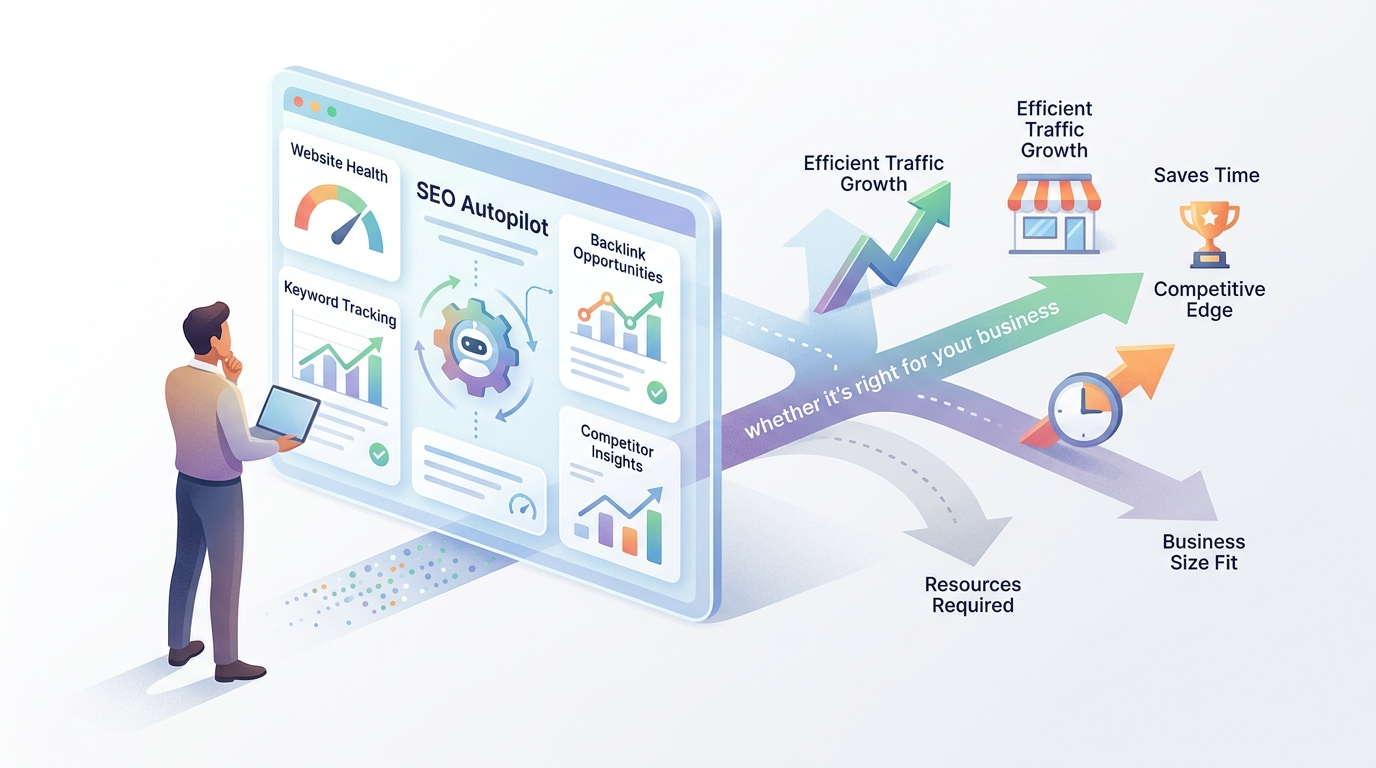
An SEO autopilot tool is software that runs your SEO tasks automatically — researching keywords, writing articles, publishing content, and tracking rankings — without you doing it manually each week. Instead of hiring an agency or learning SEO yourself, you connect the tool to your website and let it work in the background on a schedule you set.
What Does an SEO Autopilot Tool Actually Do?
Most SEO work is repetitive. Finding keywords, writing content around them, checking how your pages rank, fixing technical errors — these tasks need to happen consistently, not just once. An SEO autopilot tool handles that repetition for you.
A solid autopilot tool covers these core functions:
- Keyword research: Finds the search terms your customers are actually using
- Content creation: Writes and publishes SEO articles targeting those keywords
- Rank tracking: Monitors where your pages appear in Google search results over time
- Technical audits: Identifies site issues that hurt your rankings, like slow load times or broken links
- Social distribution: Shares your published content to social channels automatically
The goal is simple: your SEO keeps moving forward every week without you needing to think about it.
Who Actually Needs an SEO Automation Tool?
Not every business does. If you have a dedicated marketing team or already work with an agency you trust, you probably don't need this.
But if you run a small or mid-size business — a staffing agency, a local service company, a small B2B firm — and SEO keeps sliding to the bottom of your to-do list, automation makes sense. You know SEO matters. You just don't have time to do it properly.
Most small business owners fall into one of these situations:
- They tried doing SEO themselves and it never stuck
- They hired an agency and found it expensive for the results they got
- They know they're invisible on Google but don't know where to start
An autopilot SEO tool is built for that gap — consistent SEO execution without the overhead.
How Is This Different From a Regular SEO Tool?
Most SEO tools are built for marketers. They give you data and expect you to act on it. You get a keyword list — now go write the articles. You get an audit report — now go fix the issues.
An SEO autopilot tool doesn't just show you what to do. It does the work. The research, writing, publishing, and tracking all run on a schedule. You review what's been done. You don't have to drive it.
That distinction matters. Research consistently shows that businesses publishing content regularly — at least weekly — see significantly stronger organic traffic growth than those publishing sporadically. One industry benchmark puts it plainly: companies that publish 16 or more blog posts per month get roughly 3.5 times more traffic than those publishing four or fewer. Most small businesses publish almost nothing, because it takes time they don't have. Automation closes that gap.
What About AI Answer Engines Like ChatGPT and Perplexity?
Google isn't the only place customers search anymore. AI tools like ChatGPT, Perplexity, and Google's own AI Overviews now answer questions directly — and they pull from published content on the web.
If your business isn't publishing relevant, well-structured content, you won't show up in those answers either. An SEO autopilot platform that also monitors AI visibility — checking whether tools like Claude or ChatGPT mention your business when someone asks a relevant question — gives you a clearer picture of where you stand and where you're missing out.
This is a newer capability, but it's quickly becoming important. AI-generated answers are already changing how people discover businesses, especially for local services and B2B providers.
What Should You Look for in an SEO Autopilot Tool?
Before choosing one, check that it covers the basics reliably:
- Automated content publishing: Does it write and publish on a schedule, or just suggest topics?
- Real rank tracking: Does it show you actual Google positions for your target keywords?
- Technical site auditing: Does it flag SEO errors you can actually act on?
- AI visibility monitoring: Does it check whether AI answer engines mention your business?
- Simple reporting: Can you understand what's happening without an SEO background?
Be realistic about what automation can and can't do. It won't replace a skilled strategist overnight. But it will keep your SEO moving consistently — which beats doing nothing while you wait for the perfect plan.
How SEO Autopilot Works for Small Businesses in Practice
Here's what a typical weekly automated run looks like on a platform like SEO Autopilot:
- The tool researches which keywords are worth targeting this week
- It writes an SEO article targeting one of those keywords
- The article is published to your site automatically
- Your rankings are checked and logged
- A technical audit flags any new site issues
- The article is distributed to your social channels
You get a summary. You don't need to manage each step. That's the point.
If you're a small business owner tired of watching SEO sit on your to-do list, SEO Autopilot runs the whole process for you — keyword research, content, tracking, and AI visibility checks — on autopilot every week. No agency fees, no learning curve. See how it works at seoautopilot.dk.
What is an SEO autopilot tool?
An SEO autopilot tool is software that automates the core tasks of search engine optimization — including keyword research, content writing, publishing, and rank tracking — so they run on a schedule without manual effort. It's designed for business owners who want consistent SEO without managing it themselves.
Can SEO really be automated, or is it just a gimmick?
The repetitive parts of SEO — publishing regular content, tracking rankings, running site audits — can be fully automated and work well. Strategic decisions and brand positioning still benefit from human input, but automation handles the execution that most small businesses never get around to doing consistently.
How long does it take to see results from an SEO autopilot platform?
Most SEO efforts take three to six months before significant ranking improvements show up, whether you use automation or not. Automation helps by keeping output consistent every week, which is the main factor that determines long-term SEO growth for small businesses.
Does an SEO autopilot tool work for local businesses?
Yes. Local service businesses are actually a strong fit because their competitors often do very little SEO, meaning consistent automated content and technical optimization can move the needle faster. Look for a tool that tracks local keyword rankings specifically.
What is AI visibility monitoring and why does it matter for SEO?
AI visibility monitoring checks whether AI answer engines like ChatGPT, Perplexity, or Claude mention your business when someone asks a relevant question. As more people use AI tools to find services, showing up in those answers is becoming as important as ranking on Google.